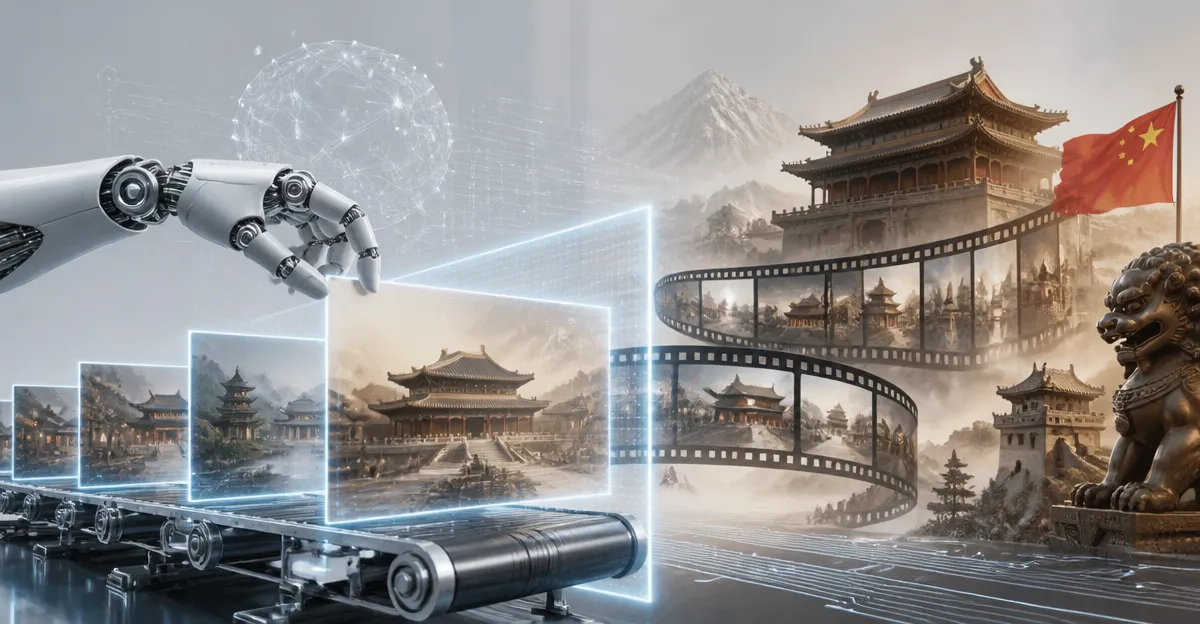
October 10, 2026, (Inside AI) — China's AI-generated historical drama sector has crossed a threshold that regulators, historians, and platform operators are still struggling to define. New industry data shows the market generated RMB 22 billion ($3.29 billion) in the first five months of 2026 alone, with full-year projections reaching RMB 40 billion ($5.98 billion). That represents 138% year-on-year growth, according to the 2026 H1 AI Drama and Animation Data Report from research firm DataEye.
The volume tells a more striking story. Between January and June, Chinese platforms released 221,900 new AI short dramas. Of those, 1,055 surpassed 100 million views each. Combined, they pulled 515.738 billion views. Monthly incremental views hit 155.78 billion in June, the highest single-month figure of the half. More than 600 million users in China now watch AI short dramas.
These numbers describe a production revolution. They also describe a verification crisis.
When Generation Outpaces Historical Verification
AI tools now let small teams and individual creators build ancient cities, palaces, and large-scale battlefields that once demanded professional production crews and massive budgets. The AI series Wielding Weapons in the Song Dynasty has maintained popularity scores above 46 million across multiple seasons. Another AI-generated series, The Later Journey to the West, aired during Hunan Satellite TV's prime-time slot and ranked first among provincial satellite channels in its time slot.
The technical achievement is real. The historical accuracy is not guaranteed.
A meticulously rendered ancient palace may not reflect the architecture of its stated period. Convincing dialogue attributed to a historical figure does not mean historical records support that exchange. AI models, when information is incomplete, generate plausible-sounding claims that lack evidentiary grounding. Errors can appear in clothing styles, artifact usage, personal biographies, and even the sequencing of historical events.
As images become more realistic, audiences may confuse visual authenticity with historical accuracy. When unverified details repeat across hundreds of thousands of titles, they can distort public understanding of history at scale.
This is not a hypothetical concern. Historical dramas have always taken creative liberties. Time travel, alternate histories, and fictionalized retellings are established storytelling devices. The problem AI introduces is volume and speed. A human writer researching a script might spend months checking sources. An AI model generates comparable output in minutes, with no built-in mechanism for distinguishing documented fact from invented detail.
AI can assist with historical research, scene design, and image generation. It cannot replace historical verification. For productions based on real events and figures, checking primary sources and consulting qualified experts remains essential.
Read: China's First AI-Produced Theatrical Film Sets October 23 Release
Regulation Arrives, But Uniform Rules May Not Fit
China's National Radio and Television Administration introduced the Measures for the Administration of Micro-Dramas, effective September 1, 2026. The rules establish a classification-based management framework covering filing, review, distribution, and disclosure labels for AI-generated content.
The regulatory approach acknowledges a key distinction. Clearly identified alternate-history stories carry different risks than productions based on real historical events that audiences may mistake for fact. Applying identical restrictions to both would be impractical and could stifle creative expression.
The focus should rest on whether a work misleads audiences, violates content rules, or fails reasonable verification standards. That requires platforms to look beyond views and engagement metrics. Stronger review processes, timely action against violations, and clear disclosures about AI involvement will matter more as content volume grows.
AI labels tell audiences how a work was made. They do not replace fact-checking or exempt productions from other content requirements.
The deeper challenge is structural. As generating images becomes easier, the scarce skill is no longer the ability to create an ancient palace. It is knowing what that palace should have looked like in its historical context. It is no longer the ability to generate a historical figure. It is understanding that person's era, background, and documented experiences.
Technology lowers the barrier to creation. It does not lower the barrier to understanding. Creators' historical knowledge, their judgment about where fiction ends and fact begins, and platforms' willingness to enforce responsible distribution will ultimately determine whether this transformation enriches or erodes public engagement with the past.