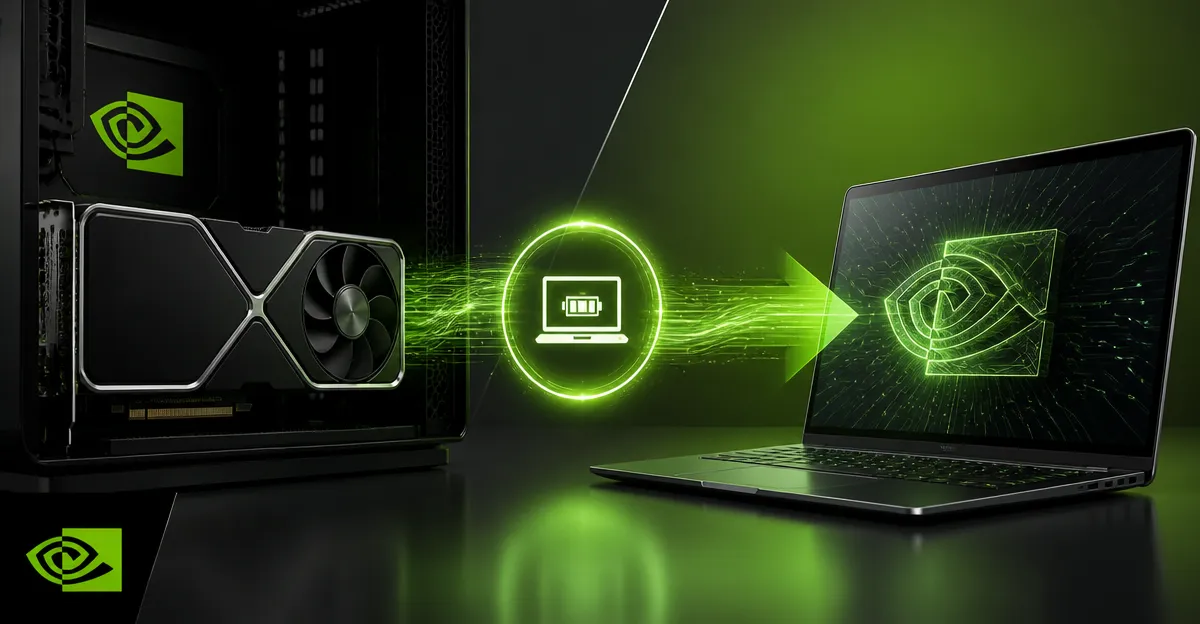
November 6, 2026, (Inside AI) — NVIDIA appears to have unintentionally extended a GPU resource management feature, originally built for its RTX Spark laptops, to desktop GeForce RTX graphics cards. The setting, called GPU App Prioritization, surfaced in NVIDIA App version 11.0.9.585 under System, then Advanced. NVIDIA has not announced or acknowledged the feature's presence on desktop GPUs, leaving users to discover it on their own. The rollout is inconsistent, with some RTX 5080 owners reporting full access while an RTX 5070 Ti user on the same software saw nothing.
The feature addresses a long-standing pain point: Windows currently allocates GPU resources between foreground and background applications without user input. GPU App Prioritization lets users manually divide GPU power between a primary app, such as a game, and background tasks, like streaming software or AI model inference. Its quiet arrival on desktops raises questions about NVIDIA's product segmentation strategy and whether this is a deliberate test or an accidental leak.
Uneven Rollout Fuels Speculation
User reports paint a fragmented picture. After updating to NVIDIA App version 11.0.9.585, some GeForce RTX 5080 owners found the prioritization controls. One user reported seeing the 90/10 Foreground Priority preset but found the custom slider blocked entirely. Meanwhile, an RTX 5070 Ti owner running the same app version and a hotfix driver saw no trace of the feature. NVIDIA has not confirmed which specific GeForce models support the tool or whether the rollout is intentional.
The inconsistency suggests two possibilities. It could be leftover code from the RTX Spark implementation that leaked into the broader app update. Or NVIDIA may be quietly testing compatibility before a formal announcement. The company has stayed silent on GeForce support, and no official documentation mentions the feature for desktop cards.
This pattern is not unprecedented. GPU manufacturers often test features in limited releases before wider deployment. However, the lack of communication leaves users guessing and creates confusion about hardware compatibility. For a company that typically controls its messaging tightly, the silence is notable.
From a strategic standpoint, NVIDIA may be gauging user interest and system compatibility before committing to a full rollout. Desktop GPU configurations vary widely, and a feature that works seamlessly on one model might cause instability on another. The company could be collecting implicit feedback through user reports while avoiding the pressure of a formal launch.
How GPU App Prioritization Works
The feature offers four preset modes. The default Standard mode splits resources 80/20, giving 80% to the foreground app and 20% to background tasks. Foreground Priority pushes that to 90/10 for maximum gaming performance while streaming. Background Priority reverses the emphasis for rendering or AI workloads. A Custom mode lets users manually adjust the ratio up to 95/5 through a step-by-step slider.
The tool requires Hardware-Accelerated GPU Scheduling to be enabled in Windows. Without it, the prioritization controls do not appear. This Windows setting, available since Windows 10 version 2004, offloads some GPU scheduling work from the CPU to the graphics card. It remains disabled by default on many systems, which may explain why some users cannot see the feature even after updating.
For streamers and content creators, manual GPU allocation could eliminate guesswork. Instead of relying on Windows to balance resources between a game and encoding software, users can set their own priority. The feature also matters for AI workflows, where a local model might run alongside creative software on the same GPU. By reserving GPU capacity for background AI inference, users could maintain smoother foreground performance.
However, the feature's dependence on Hardware-Accelerated GPU Scheduling adds a layer of complexity. Users must enable a separate Windows setting that many leave untouched. This requirement could limit adoption even if NVIDIA makes the feature official.
Read: DRAM Prices Double in 2026
NVIDIA's accidental or silent rollout of GPU App Prioritization on desktop RTX cards highlights a broader tension in hardware feature deployment: the gap between controlled launches and organic discovery. If the feature proves stable and popular, NVIDIA may face pressure to formalize support across all GeForce models. If it remains inconsistent, users may grow frustrated with the lack of clarity. Either way, the company's next move will signal whether this was a misstep or a calculated test.

If a research paper dropped this week, Mahesh has already read it. He covers AI tools and vibe coding for builders who need to know what is worth their time and what is not.