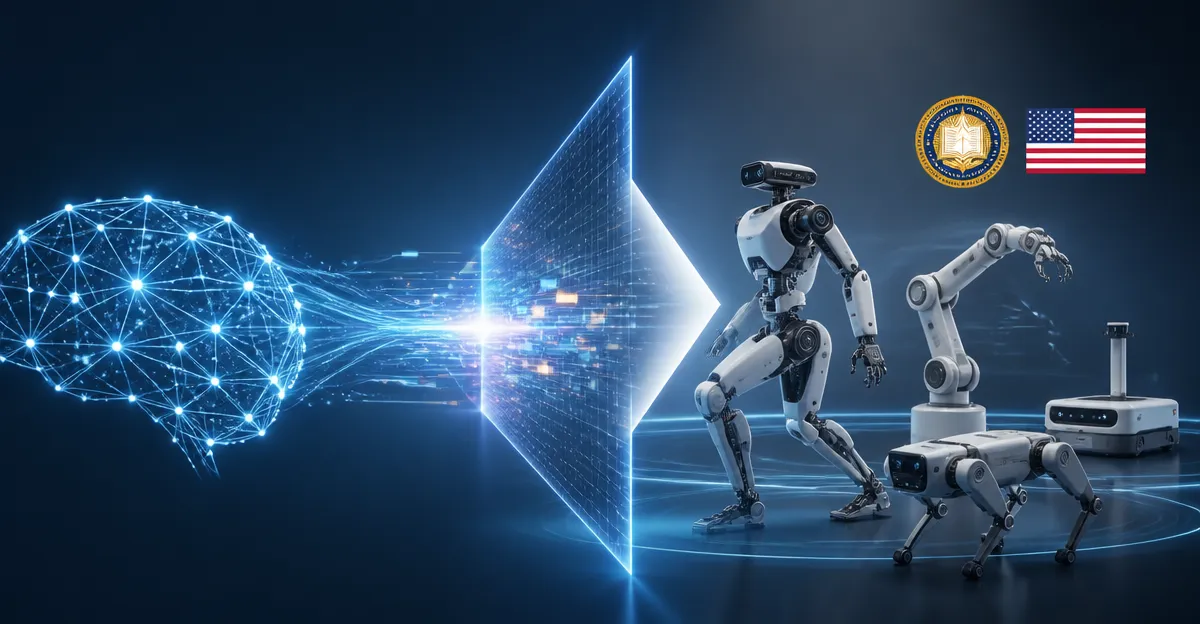
November 9, 2026, (Inside AI) — A new approach called "agentic robotics" could bypass the two biggest bottlenecks in robotics: the enormous data requirements and intensive engineering needed to program robots. Ken Goldberg, a professor of engineering at UC Berkeley, presented the method this week at the Conference on Robot Learning, alongside Spencer Huang, director of robotics engineering at NVIDIA, and a team of researchers. The team is releasing open-source code built on NVIDIA's Isaac simulation framework and an industry-standard benchmark for evaluating robot performance on industrial tasks.
The announcement matters because robotics has long lagged behind AI's rapid progress in language and vision. Goldberg himself warned last year of a "100,000-year data gap" that would prevent robots from acquiring real-world skills as quickly as AI agents have gained language fluency. Agentic robotics, he says, offers a way around that gap by using teams of AI agents to generate, test, and refine robot-control programs in simulation, without requiring massive new data collection.
How Agents Rehearse Robot Programs
Traditional robotics follows two paths. Model-based robotics relies on engineers directly programming perception, planning, and control, which demands extensive engineering. Model-free robotics trains robots through imitation learning, which requires enormous amounts of demonstration data and time. The new approach, detailed in a framework called Graph-as-Policy, segments robot tasks into individual skills such as finding an object, planning a grasp, and moving the gripper without collisions. AI agents then generate and connect these skills into a complete robot program. Using NVIDIA's Isaac simulation libraries, the agents autonomously rehearse the program across task variations, identify failures, and refine the approach before deployment.
"Agentic robotics is a fundamental shift in how robots are controlled," Goldberg said. "Instead of collecting massive amounts of data and hand-tuning every behavior, teams of agents can quickly generate, test and refine robot programs that allow human engineers to interpret how the programs work for fine-tuning and verification."
Read: GenRobot AI Raises $100 Million for Robot Training Data
The approach gained momentum with the release of OpenAI's Astra model. Goldberg's postdoctoral students Eric Kaiyuan Chen and Shuangyu Xie gave Astra access to their simulation interface and a short video of a real robot wiping ink off a metal bar with a sponge. In less than an hour, the AI tool created and fine-tuned a physics simulation that accurately reproduced the video, including realistic deformations of the sponge. The researchers then gave the AI that simulation and their Graph-as-Policy framework. The AI generated a robot-control program and repeatedly tested and improved it in simulation. When the researchers ran the resulting code on a real robot, it worked.
In one trial, the robot pushed over the metal bar because it did not reliably infer its mass. The misstep created new evidence for the agent to review. The AI used video of the failed attempt to improve its simulation, revise the robot's control program, and test a new approach. "This is when I got goosebumps," Goldberg said.
"Robots are advancing quickly, but developing them for real-world environments remains slow, data-intensive and difficult to scale," Huang said. "Working with UC Berkeley, NVIDIA is helping advance a new approach combining agentic AI, simulation and open industrial task-focused benchmarks to help developers rapidly test and improve robot behavior before deployment."
The industrial implications are already materializing. Berkeley-based Ambi Robotics, which specializes in logistics and warehouse order fulfillment, applied the new methods earlier this year to analyze parcel sorting data and test updates to robot behavior. Tests showed an increased capacity of over 15,000 packages sorted annually per robot; the change is now deployed across 30% of the company's U.S. fleet.
"AI-powered industrial robots must continuously improve reliability and performance," said Jeff Mahler, Ambi Robotics' co-founder and chief technology officer. "Agentic robotics converted production data into robot behavior updates, increasing throughput across our U.S. fleet while keeping engineers in control."
Goldberg said the implications are promising in industrial settings where tasks are repetitive and at scale. He cautioned not to expect home assistants to fold laundry yet, but noted that the ability to self-improve key elements of tasks is a major leap forward. He compared the moment to only two others in his 40-year career: the public release of the World Wide Web in 1993 and the debut of ChatGPT in 2022.
Read: Spirit AI Predicts Robot Brain Breakthrough by Mid-2027, Homes Eight Years Away
"Agentic robotics combines classical control theory and physics with rapidly evolving agentic coding," Goldberg said. "It's fast and practical for real engineering applications. My sense is that it's a true paradigm shift."
The open-source release and benchmark could accelerate adoption across the robotics community, but questions remain about how well the approach generalizes beyond structured industrial tasks. Goldberg's team is presenting results from months of testing, and the code is available for other roboticists to experiment with. The benchmark aims to standardize evaluation across industrial tasks, which could help compare different agentic approaches. For now, the focus is on logistics and warehouse automation, where repetitive tasks and existing data make the method practical. Home robotics, with its unstructured environments and unpredictable variables, remains further off.

Tobias is less interested in what a robot or a prompt can do today than in what it means for tomorrow. He writes about prompt engineering and robotics for readers who want context, not just specs.