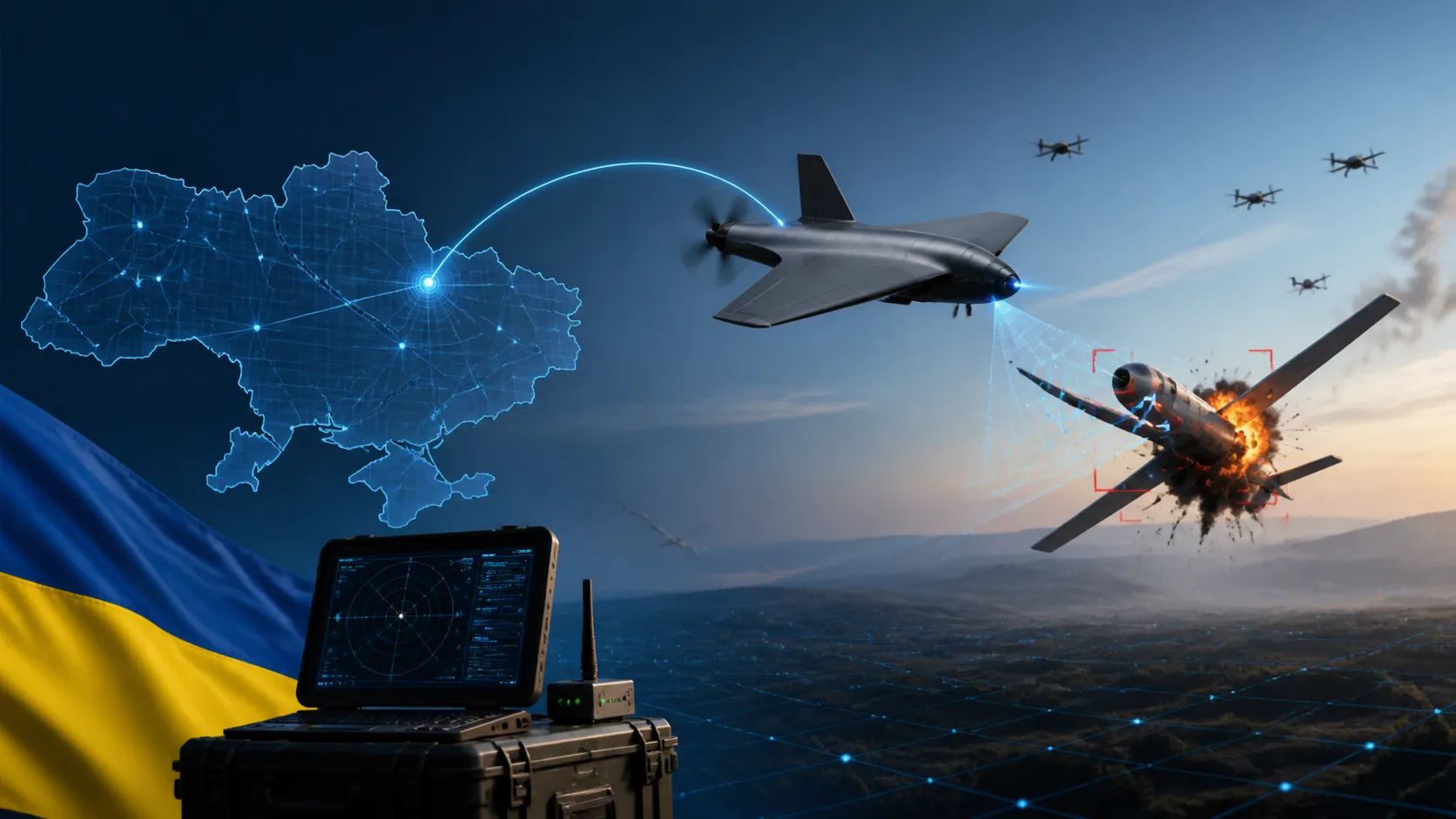
June 17, 2026, (Inside AI) — Ukraine has deployed AI-powered interceptor drones to counter Russia’s escalating Shahed drone and missile barrages, marking a pivotal shift in cost-effective aerial defense. The P1-Sun Long, an AI-assisted system, autonomously tracks and engages threats while retaining human command over lethal decisions.
The AI Shield Rises Over Ukrainian Skies
At a pine forest test site in central Ukraine, engineers recently showcased the P1-Sun Long, one of the nation’s first AI-assisted interceptors. It locked onto a replica Shahed drone, demonstrating how machine vision can spot threats before human eyes. The system then guided itself into attack position, with a pilot approving the final strike.
This innovation responds to relentless Russian barrages. In a single recent assault, Russia launched over 600 drones and 70 missiles, according to Ukrainian officials cited by Firstpost. The Shahed, an Iranian-designed loitering munition, has become a staple of Moscow’s attrition strategy, straining Kyiv’s traditional defenses.
From Machine Guns to Machine Minds
Early war tactics relied on heavy machine guns, electronic jamming, and surface-to-air missiles. Ukraine later introduced human-piloted interceptor drones. Now, companies like SkyFall embed AI to sharpen detection and tracking, The New York Times reported. Their software trained on over 10,000 videos of Shahed interceptions, leveraging a vast archive of combat footage.
Read: Ukraine Plans Domestic AI Computing Capacity with Kyivstar Amid War
Brave1, Ukraine’s defense tech hub, urges firms to operationalize battlefield data for AI training. During tests, the AI flagged targets before operators visually confirmed them. Once engagement was authorized, the software handled tracking, but a human always commanded the final strike.
The Ethical Frontier of Algorithmic Warfare
AI’s creep into weaponry extends beyond drones. Unmanned ground vehicles with machine guns use AI vision for threat identification. Some missiles employ autonomous terminal guidance, locking on in final flight phases. These advances shrink the human role, raising alarms among rights groups.
President Volodymyr Zelensky acknowledged the peril, warning that fully autonomous weapons could arrive sooner than expected. “The remaining barriers are increasingly ethical rather than technological,” experts told The New York Times, as nations rush to militarize AI.
Keeping Humans in the Loop, for Now
Ukrainian officials insist on meaningful human control. Current systems assist but do not decide lethal action independently. Yet the pressure to automate grows as drone swarm attacks intensify. The P1-Sun Long exemplifies a delicate balance: faster, cheaper intercepts without ceding moral responsibility to code.
Read: Grok AI Used in U.S. Strikes on Iran, Pentagon Confirms in Court Filing
As the war grinds on, Ukraine’s AI interceptors may redefine air defense economics. A single Shahed costs roughly $20,000; traditional missiles can exceed $1 million. AI drones slash that ratio, but the true cost may be measured in the erosion of human judgment over life and death.