July 25, 2026, (Inside AI) — Anthropic has published a technical guide detailing how developers can build verification loops in Claude Code using skills, turning manual code review steps into automated, iterative self-checks. The post, released on the company’s official blog, outlines a method for encoding project-specific rules into reusable skill files that Claude executes autonomously during agentic coding sessions.
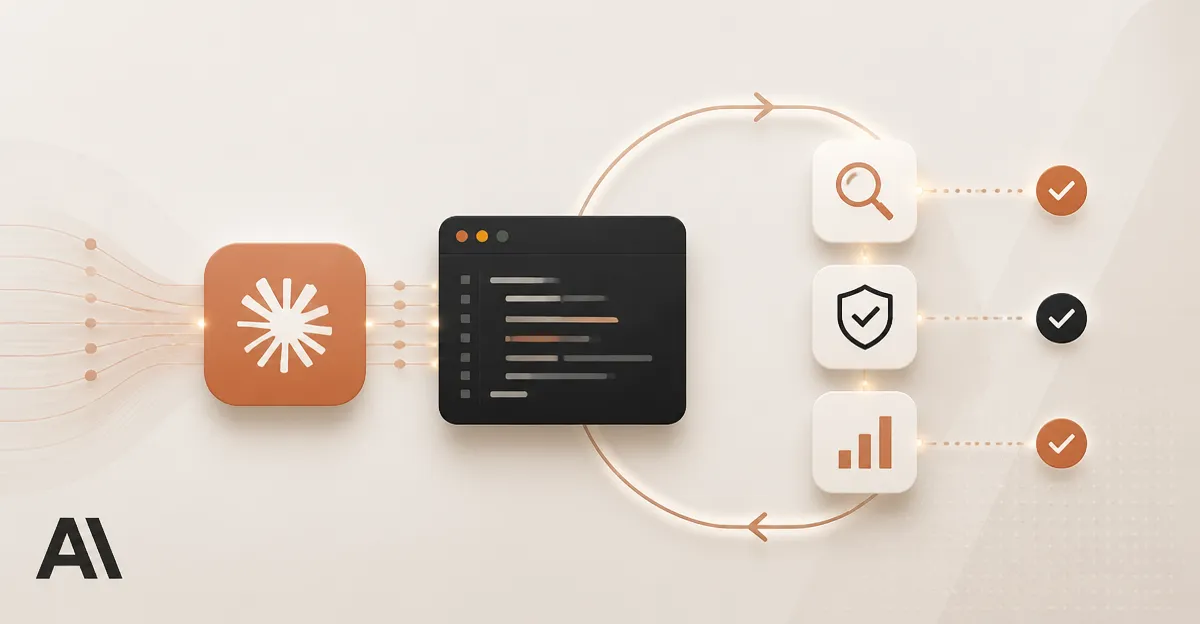
The core insight: most agentic coding follows a loop—request, gather context, act, verify, repeat. While Claude already leverages deterministic signals like type checkers, linters, and test suites, many verification steps remain manual. Anthropic’s solution transforms these into persistent, automated feedback cycles.
Verification loops are defined as repeating cycles where the AI agent checks its own work—running tests, linters, or custom checks—and fixes failures before proceeding. Packaged as skills, these loops ensure consistent enforcement across every session without human prompting.
Anthropic’s engineering team shared internal practices, including built-in tools like the /verify skill, which builds, runs, and observes application changes. They also highlighted Code Review, a managed multi-agent service in research preview that runs automated review passes on pull requests. Users can close the loop by commenting @claude on findings when GitHub Actions are configured.
For custom loops, the guide advises developers to document every manual correction they repeatedly make. “Write down everything that you find yourself doing every time,” the post states. Even deterministic rules like “Reject any migration that drops a column without a backfill step” qualify for capture, as generic linters miss project-specific constraints.
Anthropic also recommends listing exact build and test commands in the CLAUDE.md file so Claude doesn’t infer them. This aligns with the toolchain approach, where Claude catches and acts on error codes from any provided tool. For new projects, developers should write best-practice verification steps in plain English, as if handing them to a new teammate.
“If you’re struggling to articulate the verification check itself, ask Claude for best practices first and edit from there,” the guide suggests. The differences between generic advice and your specific needs are exactly what to encode.
Other built-in features include spec validation, a skill that verifies changes against a markdown spec, and rubrics in Claude Managed Agents, a beta service using a separate grader agent to evaluate outcomes against a rubric, automatically looping failures back for rework.
This approach mirrors broader industry efforts to enhance agent reliability through self-verification. Research on self-refinement shows that LLMs can improve their own outputs via iterative feedback, a principle Anthropic operationalizes here. However, challenges persist: verification loops depend on well-defined checks, and ambiguous requirements can lead to infinite cycles or missed edge cases. Anthropic’s emphasis on explicit, project-specific rules addresses this, but the onus remains on developers to articulate constraints precisely.
The guide stops short of addressing how to handle verification failures that require external context or human judgment—a known limitation in autonomous coding agents. Competing tools like GitHub Copilot’s agent mode and Cursor’s AI review features offer similar iterative fixes but lack Anthropic’s deep integration of custom, file-based skills. Anthropic’s official documentation provides further technical details on skill configuration.
Anthropic’s release signals a maturation of agentic coding workflows, shifting from one-shot generation to persistent, self-correcting systems. As verification loops become standard, the next frontier may involve cross-session learning, where agents accumulate project-specific knowledge over time.