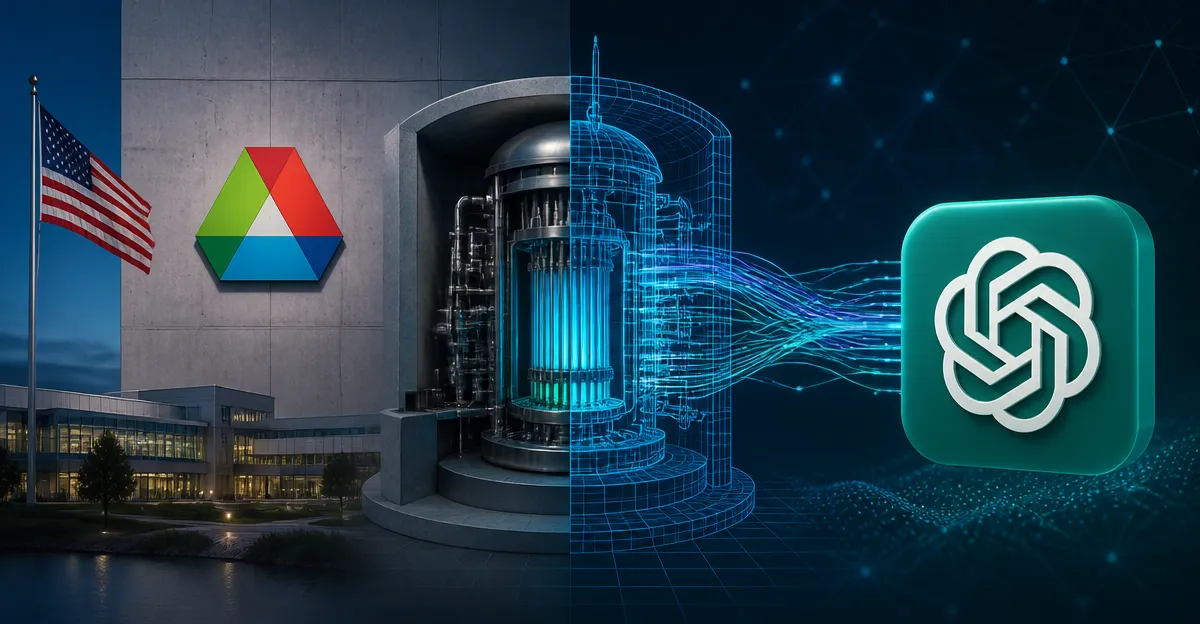
July 30, 2026, (Inside AI) — Researchers at Argonne National Laboratory have repurposed the transformer architecture behind ChatGPT to simulate fluid dynamics and heat transfer inside advanced nuclear reactors. The adaptation integrates directly into Argonne’s System Analysis Module (SAM), a tool for evaluating next-generation reactor designs.
Traditional turbulence modeling is computationally brutal. Detailed simulations capturing chaotic fluid behavior can take days or weeks. Simpler models run faster but sacrifice accuracy critical for safety. The transformer-based approach analyzes relationships between physical data points, locations, velocities, and flows across an entire system simultaneously.
Rui Hu, principal nuclear engineer at Argonne, framed the breakthrough directly.
"With AI, we can be as accurate as the complex methods and as fast as the simple methods. It is a union of accuracy and speed."
The model has demonstrated high accuracy in representing resistance to fluid flow and heat transfer. Argonne reports that AI-based models now produce simulation results almost instantaneously while matching the accuracy of computationally expensive methods. This speed enables engineers to test more design variations and evaluate safety scenarios more thoroughly.
For nations developing nuclear energy programs, including Pakistan with its ongoing discussions around small modular reactors, AI-accelerated simulation tools could reduce development timelines and lower safety validation costs. The work receives funding from the US Department of Energy’s Nuclear Energy Advanced Modeling and Simulation (NEAMS) Program.
Transformers Tackle Turbulence
Transformer architectures, originally designed for natural language processing, excel at capturing long-range dependencies in sequential data. In fluid dynamics, turbulent flows exhibit complex spatial and temporal correlations. Argonne’s team treats reactor fluid data as sequences, allowing the model to learn patterns that govern heat transfer and pressure drops.
This approach bypasses the need to solve the Navier-Stokes equations directly for every time step. Instead, the model predicts flow behavior based on learned representations. The result is a surrogate model that approximates high-fidelity simulations at a fraction of the computational cost.
Argonne’s SAM code has been validated against experimental data from facilities like the Advanced Test Reactor. Integrating AI surrogates required retraining on reactor-specific datasets, including temperature profiles and coolant velocity fields. The model’s ability to generalize to unseen operating conditions remains an active area of research.
Digital Twins Demand Speed
The next phase targets digital twins of entire nuclear power plants. These virtual representations would model not just the reactor core but cooling systems, safety mechanisms, and auxiliary equipment operating together in real time. Argonne researchers say they are among the first teams exploring transformer architectures for digital twin technology in nuclear systems.
Digital twins require continuous data assimilation from sensors. Fast AI surrogates enable real-time updates, allowing operators to predict component failures or optimize maintenance schedules. The International Atomic Energy Agency has highlighted digital twins as a key enabler for advanced reactor deployment, but computational bottlenecks have hindered adoption.
Argonne’s work aligns with broader efforts to apply machine learning in nuclear engineering. Argonne’s team is developing methods to estimate prediction confidence, a requirement for regulatory acceptance.
Faster simulations could also accelerate licensing for new reactor designs. The Nuclear Regulatory Commission requires extensive safety analyses, which often rely on conservative assumptions due to computational limits. AI surrogates could enable more realistic scenario modeling, potentially reducing over-engineering and costs.