August 2, 2026, (Inside AI) — A cascade of Chinese technological breakthroughs last week sent shockwaves through global stock markets, triggering a sharp sell-off in AI-linked semiconductor shares and exposing deep anxieties about the opaque AI economy’s dependence on a single company: Nvidia.
The turmoil began on Monday when Chinese memory chipmaker CXMT debuted on the Shanghai stock market, its valuation rocketing 466% to 3.3 trillion yuan (£365bn). Simultaneously, reports emerged that China had developed domestic deep-ultraviolet lithography tools, a technique previously monopolized by Dutch firm ASML.
The news battered semiconductor stocks worldwide. South Korea’s Kospi index plunged 11.5% on Tuesday and another 6% on Wednesday, weighed down by SK Hynix and Samsung Electronics. By Thursday, the tech-heavy Nasdaq briefly entered correction territory, falling over 10% from its recent high. Nvidia shed more than 5%, ceding its spot as the world’s largest listed company to Apple.
Yet Friday brought a fierce rebound. Strong earnings from Amazon and Microsoft restored confidence, and the Kospi surged nearly 20%. Despite the recovery, the week’s damage left the index with its worst monthly performance since October 2008.
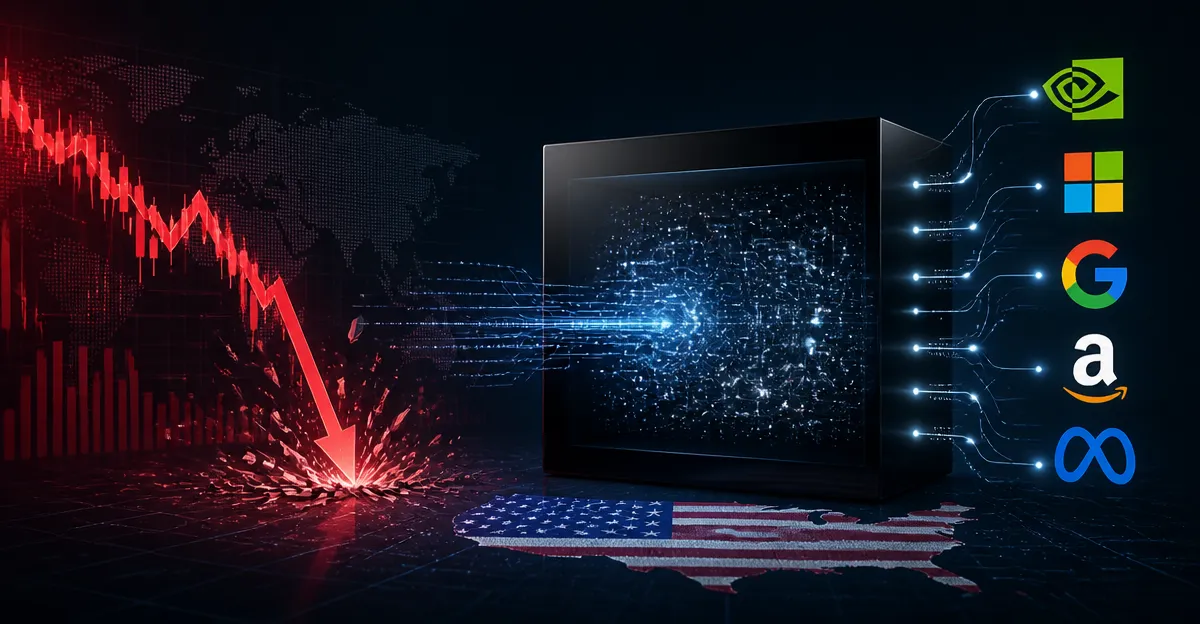
The sell-off, analysts argue, reflects more than jitters over Chinese competition. It illuminates a fragile AI economy built on circular, opaque deals and the fortunes of Nvidia, the sole company profiting from the AI boom. The rout was amplified by a report that Nvidia is considering a a $250 billion backstop for an OpenAI datacenter project, just months after a $100 billion deal between the two collapsed. Morningstar cited this as a significant factor in Nvidia’s decline, stoking fears that the chipmaker has become, in effect, the “central bank of AI.”
Memory Chips vs. AI Brains: A Misplaced Panic?
CXMT’s blockbuster IPO, while dramatic, poses little direct threat to Nvidia. The Chinese firm produces dynamic random-access memory (DRAM) chips, which store data for AI computations. These are complementary to, not replacements for, the graphics processing units (GPUs) that Nvidia designs as the “brains” of AI systems.
“SK Hynix, Micron, others, they can’t produce enough memory chips to begin with … the demand keeps growing even higher,” said Alvin Nguyen, an analyst at Forrester, calling the sell-off an “overreaction.” The global memory chip shortage is expected to persist until 2030, he noted, meaning CXMT’s entry could actually ease supply constraints rather than disrupt incumbents.
The greater long-term concern is China’s reported mastery of deep-ultraviolet lithography. These precision lasers, essential for etching circuits on silicon wafers, have been ASML’s exclusive domain. If Beijing can reliably produce such tools, it could eventually fabricate GPUs rivaling Nvidia’s. But experts caution that commercial viability is distant.
“Fabs [semiconductor fabrication plants], as I know them, still take years to develop,” Nguyen said. Mark Boost, CEO of cloud company Civo, agreed: “Manufacturing a handful of [deep-ultraviolet] machines is a massive symbolic victory, but not a commercial replacement for ASML overnight. Fabs run on efficiency and yield, and until these Chinese tools can match western reliability, ASML’s global dominance remains structurally safe outside mainland China.”
The Nvidia Nexus: A House of Cards?
Behind the week’s volatility lies a deeper structural unease. Nvidia’s ascent has made it the linchpin of the AI economy, with its chips powering everything from cloud hyperscalers to startup training runs. This concentration risk is compounded by opaque financial arrangements, such as the proposed OpenAI backstop, which blur the lines between supplier and customer.
Chris Beauchamp, chief market analyst at IG, drew a historical parallel: “These Chinese chip companies appear poised to do to the big chipmakers what they have done to steel, automobiles and a host of other industries, namely undercut them and outcompete them on price.”
Such a shift, if it materializes, would not only threaten Nvidia’s margins but could unravel the circular flow of capital that sustains the AI sector. As Nguyen put it: “Nvidia knows the gravy train’s going to run out. Everybody’s waiting for them to fall apart. I don’t know that they will because what they do still has value … at some point in the future, they’ll no longer be one of the most valuable companies in the world. Maybe … they’ll be worth only $2tn. It’s still pretty good.”
For now, Nvidia’s shares are creeping back up, but the episode has laid bare the market’s fragility. The AI economy, for all its promise, remains a bet on a single company’s ability to stay ahead of both technological disruption and its own opaque financial engineering.