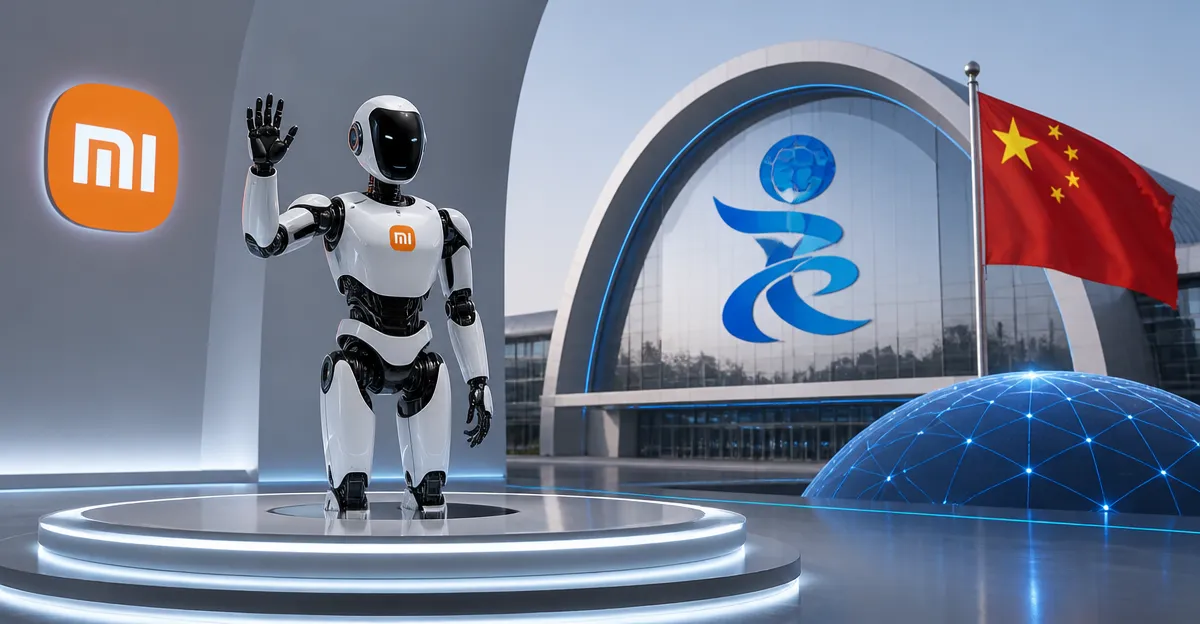
August 19, 2026, (Inside AI) — Xiaomi will publicly showcase its robot for the first time at the 2026 World Robot Conference in Beijing, running from Aug. 19 to Aug. 23. Lu Weibing, Xiaomi’s president, confirmed the debut during an earnings-call report.
The move signals Xiaomi’s deepening investment in embodied intelligence, but not as a standalone consumer product. Lu clarified that Xiaomi does not plan to sell the robot separately. Instead, the company will integrate robotics into its existing ecosystem spanning smart factories, mobility, and household applications.
This strategy mirrors how Xiaomi entered the electric vehicle market with the SU7 sedan, not merely as a product launch but as a node in a connected lifestyle. The robot’s public appearance is a calculated step, not a commercial release.
Xiaomi Bets on Ecosystem Integration, Not Standalone Robots
Lu’s statement reframes Xiaomi’s robotics ambition. Rather than competing head-to-head with Tesla’s Optimus or Unitree’s quadruped lineup, Xiaomi positions its robot as an extension of its “human, car and home” strategy.
“We do not plan to develop the robot as a standalone product. Instead, we intend to connect our robotics work with our broader human, car and home ecosystem, including smart factories, mobility and household applications,” Lu Weibing, President, Xiaomi
This approach leverages Xiaomi’s existing manufacturing scale and HyperOS software layer. The company has already deployed over 100 robots in its smart factory in Changping, Beijing, for material handling and quality inspection. Those deployments are operational, not experimental.
Analysts note that ecosystem integration reduces risk. Instead of betting on consumer robot sales, Xiaomi can amortize robotics R&D across its automotive and appliance divisions. The robot becomes a capability, not a product line.
Why the World Robot Conference Debut Matters
The World Robot Conference has become China’s most important stage for embodied AI. Last year, over 600 exhibitors and 27 humanoid robots appeared, including UBTech’s Walker S and Agibot’s general-purpose models.
Xiaomi’s absence until now was conspicuous. The company had shown early robotics work with CyberDog, a quadruped platform, but paused public updates. This debut suggests a shift from research to deployment readiness.
Beijing’s government listed the conference dates, confirming the event’s official backing. For Xiaomi, the venue offers a controlled environment to demonstrate factory automation and home assistance without promising consumer availability.
The robot’s specific capabilities remain undisclosed. Xiaomi has not revealed whether it will showcase a humanoid form factor or a wheeled mobile manipulator. However, the company’s smart factory focus implies industrial tasks like bin picking, assembly, and logistics.
Competitors are moving fast. Tesla plans limited Optimus production in 2026, while Chinese rivals Unitree and Zhiyuan Robotics have already shipped developer units. Xiaomi’s ecosystem play may be a differentiator, but speed matters.
Xiaomi’s earnings call also highlighted strong automotive growth, with SU7 deliveries exceeding 200,000 units. Robotics could follow a similar trajectory, starting as an internal tool before expanding outward.
For now, the conference appearance is a signal. Xiaomi is serious about embodied AI, but on its own terms: integrated, scaled, and quiet until proven.