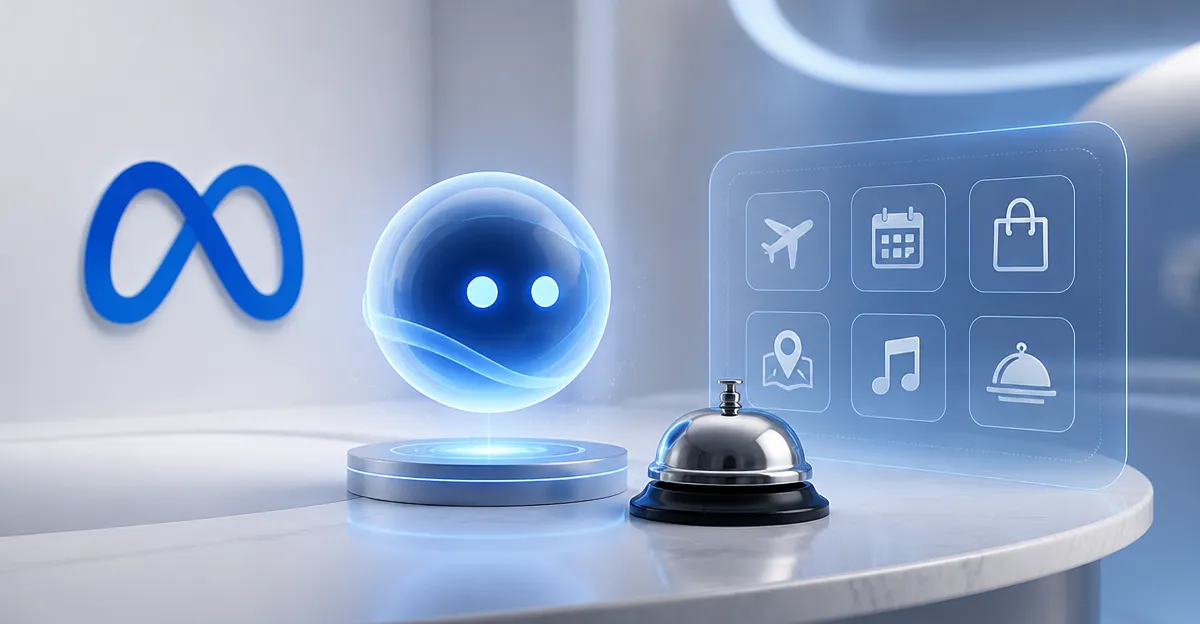
September 22, 2026, (Inside AI) — Meta has been quietly testing a "human concierge" system for its new personal AI assistant, Muse, in which human contractors handle some phone calls placed through the digital agent, according to internal company posts seen by sources.
The Facebook and Instagram parent told employees about the test last week, shortly after publicly launching a phone calling feature for Muse. The disclosure has sparked internal privacy concerns, with some employees warning that sensitive information could be unintentionally shared with contractors in call centers.
Meta spokesperson Daniel Roberts said the response from employees has been "overwhelmingly positive" and that the test aims to "get feedback so we can implement safety and privacy protections and improve features before we release them publicly."
"We're working with merchants to continue improving this potential calling feature, and will only roll it out when it's ready and with the proper disclosures," Roberts added.
The revelation highlights a growing tension in the AI industry: as companies race to deploy autonomous agents that can make calls, book appointments, and interact with businesses on behalf of users, the technology often requires human fallback to handle edge cases. Meta's approach mirrors a broader pattern where AI systems are marketed as fully autonomous but rely on hidden human labor to function reliably.
Muse, Meta's entry into the competitive personal AI assistant market, launched its phone calling feature earlier this month. The feature allows users to delegate calls to the AI, which can handle tasks like reservations or customer service inquiries. However, the human concierge test suggests the AI cannot yet manage all scenarios independently.
Employees who viewed the internal posts raised alarms about data handling. If a user asks Muse to call a doctor's office or a financial institution, the AI might transfer the call to a human contractor who then hears private medical or financial details. Those contractors, often located in call centers, may not be bound by the same privacy standards as full-time Meta employees.
Meta did not disclose how many contractors are involved, where they are located, or what data retention policies apply to the calls they handle. The company also did not specify whether users are informed when a human takes over.
This is not the first time AI companies have faced scrutiny over human involvement in supposedly automated systems. In 2023, Bloomberg reported that Amazon's Just Walk Out stores relied on human reviewers in India to verify purchases. Similarly, Google's Duplex demo in 2018 faced backlash when it was revealed that human operators would sometimes monitor calls without disclosure.
Meta's test comes as regulators worldwide increase scrutiny of AI systems that handle personal data. The European Union's AI Act, which fully applies from August 2026, requires transparency when humans are involved in AI decision-making. In the United States, the Federal Trade Commission has signaled interest in AI practices that deceive consumers about automation.
The internal concerns at Meta reflect a broader unease within the company about balancing rapid AI deployment with user trust. Muse competes with OpenAI's ChatGPT voice mode, Google's Gemini, and Amazon's Alexa+, all of which have faced questions about privacy and human oversight.
Meta has not announced a timeline for when or if the human concierge feature will be released publicly. The company said it will only roll out the feature "when it's ready and with the proper disclosures." For now, the test remains limited, but it raises fundamental questions about the true cost of AI convenience.