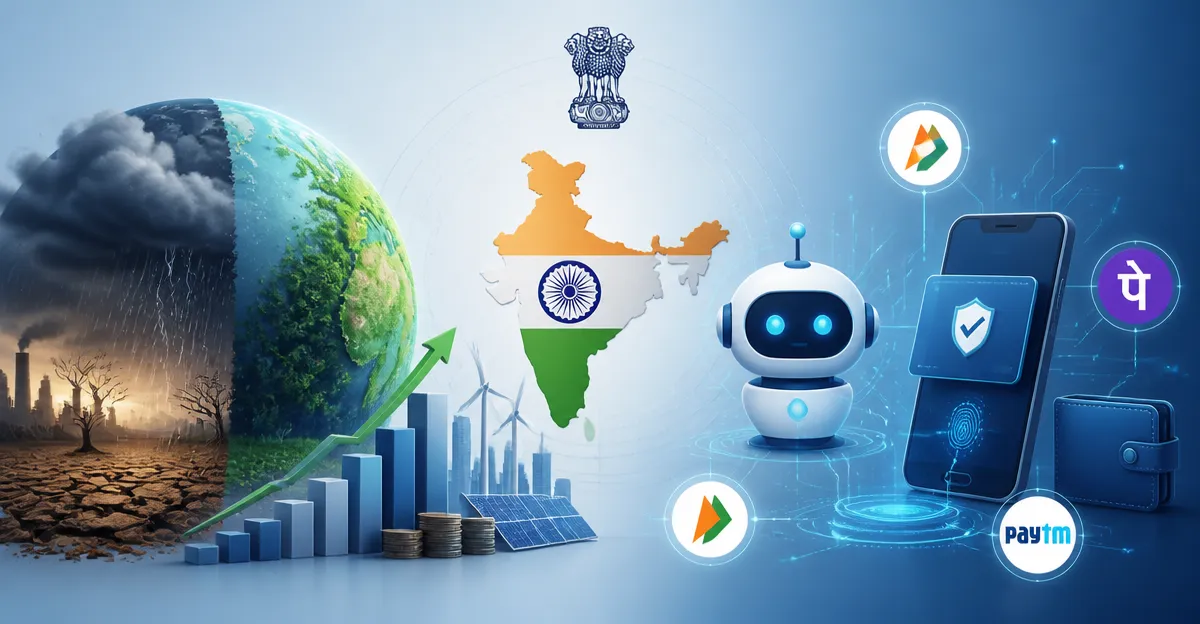
September 23, 2026, (Inside AI) — India's civil services examination has formally recognized agentic artificial intelligence as a core topic for governance and economic policy, with this week's GS-3 practice questions asking aspirants to examine both the opportunities and risks of AI-assisted financial decision-making in the country's digital payments ecosystem.
The inclusion of agentic AI alongside climate change economics in the UPSC Mains syllabus signals a significant shift in how India's administrative apparatus is preparing for technological disruption. The question specifically asks candidates to analyze how agentic systems can transform digital payments from user-initiated transactions to autonomous financial decision-making, a transition already underway across India's fintech sector.
Agentic AI refers to systems capable of executing tasks within defined parameters without constant human prompting. In the payments context, these systems can locate products, compare options, select appropriate payment methods, and complete transactions with minimal user intervention. The technology represents a fundamental departure from the current UPI model, where every transaction requires explicit user authorization.
Where Agentic Systems Meet India's Payment Rails
The opportunities extend beyond convenience. According to the examination framework, AI agents can reconcile bills, match purchase orders, arrange payments, and manage working capital for businesses. They can forecast cash-flow shortages, identify checkout errors, and initiate refund or customer-recovery operations automatically. These capabilities could democratize access to features previously reserved for large enterprises with sophisticated ERP systems.
Read: Amazon Sues Perplexity Over AI Agent Purchases While WeChat Opens Controlled Access
India's digital public infrastructure provides a unique foundation for this transition. The combination of AI with DPI has the potential to reduce transaction costs, improve resource allocation, and address information asymmetry in financial services. The country's UPI system, which processes billions of transactions monthly, generates the data volume necessary for training and deploying agentic systems at scale.
Fraud detection represents an area where AI integration is already mature. Payment platforms use machine learning to assess risk and analyze transaction patterns in real time. Agentic systems could make these defenses more responsive to emerging threats by adapting to unusual patterns without human intervention.
However, the challenges remain substantial. Payment data sits scattered across banks, gateways, merchants, and legacy systems, creating fragmentation that complicates large-scale agentic deployment. The examination notes that rising security expenditures for UPI platforms as they adapt to AI-related cybersecurity threats could strain smaller participants.
Data governance presents another hurdle. Agentic systems require access to financial and behavioral information to function effectively. Informed consent, limited data use, and ongoing customer oversight will be critical safeguards. The question of accountability when an AI agent makes a poor financial decision remains unresolved in most regulatory frameworks.
The cost of training AI models and integrating them into existing payment infrastructure requires tremendous financial and technological resources. Some businesses may find the benefits insufficient to justify the investment initially, potentially creating a two-tier system where only large players can deploy agentic capabilities.
The parallel question on climate change economics underscores the interconnected nature of these policy challenges. The Himalayas support economic activity worth 21.5% of India's FY24 GDP, primarily through water, agriculture, hydropower, industry, and services. Climate-driven melting threatens water security across the Indus, Ganga, and Brahmaputra basins, with post-peak water declines expected to severely impact agriculture across the Indo-Gangetic plains.
Volatile river flows, landslides, and flash floods disrupt regional hydropower, particularly in the Northeast. Frequent disaster damage to transport, energy, and tourism infrastructure inflates reconstruction costs, diverting public funding from development and climate adaptation initiatives. The economic significance extends beyond mountain states, as agriculture, industries, services, and supply lines all rely on Himalayan-fed rivers.
Read: AI agents can do your tasks: How, and how much should you let them?
The examination framework identifies several factors aggravating vulnerability, including highway expansion, hydropower construction, and tourism facilities in fragile valleys. Soot accumulated on snow darkens surfaces and enhances solar radiation absorption, accelerating melt. Climate change compounds with earthquakes, landslides, glacial lake outburst floods, and heavy rains to create complex disaster chains.
Himalayan rivers, glaciers, and air pollutants transcend governmental boundaries, rendering fragmented administration ineffective. The conclusion calls for a unified Himalayan strategy centered on climate adaptation, disaster-resilient infrastructure, robust scientific monitoring, emissions mitigation, and cross-border cooperation.
For agentic AI, the long-term adoption depends on overcoming fragmented data, cybersecurity, accountability, and cost concerns while maintaining significant user control. The examination's inclusion of both topics reflects India's dual challenge: managing environmental risks to macroeconomic stability while positioning itself as a leader in responsible AI deployment.
The UPSC question on agentic AI follows a 2026 previous year question that asked candidates to explain the working of agentic AI, describe its applications, and discuss associated advantages, risks, and challenges. This progression suggests the examination is moving from conceptual understanding to applied policy analysis.
India's approach to agentic payments will likely influence global standards, given the country's leadership in digital public infrastructure. The integration of AI with DPI could serve as a model for other nations seeking to modernize financial systems while maintaining consumer protection.
Both questions reflect the UPSC's recognition that technological and environmental disruptions are not separate policy domains but interconnected challenges requiring integrated responses from India's administrative leadership.