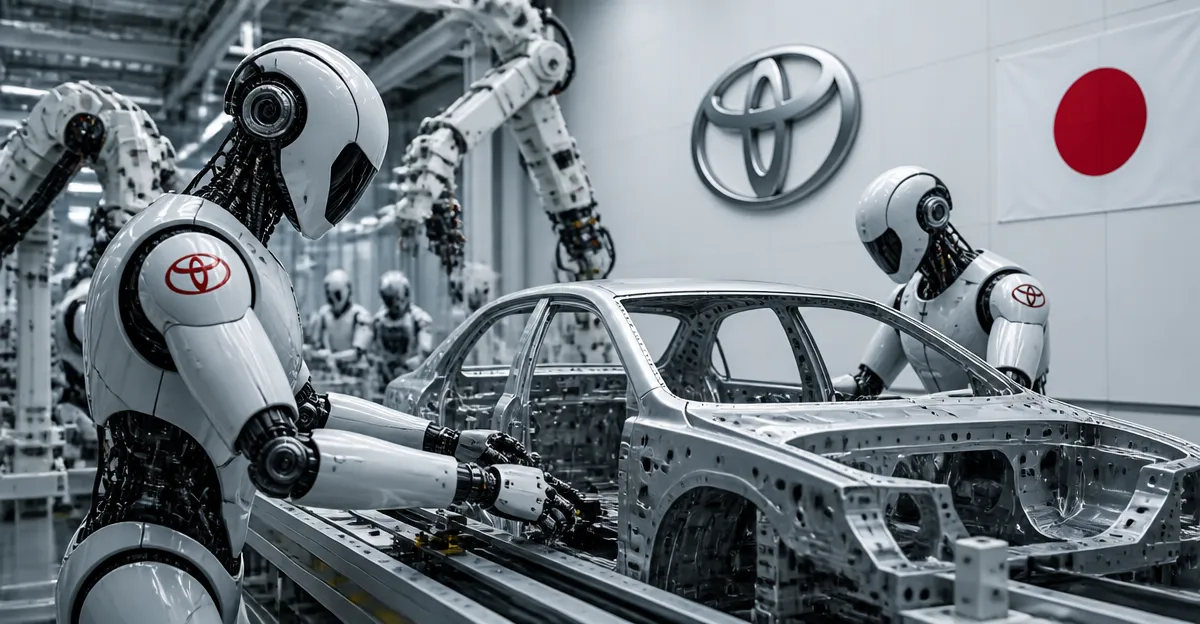
November 26, 2026, (Inside AI) — The gap between humanoid robot demonstrations and dependable factory work has become the central theme at Factory Innovation Week 2026 in Tokoname, in central Japan's Aichi prefecture, the home region of Toyota Motor. Automotive and robotics companies gathered there to test whether humanoids paired with physical AI can move from stage demonstrations into real production lines.
The event's location matters. Aichi hosts one of the world's densest clusters of automotive suppliers and machine builders. Any humanoid that cannot survive a shift on those floors has little commercial future. Vendors arrived with working prototypes and left with harder questions about cost, uptime, and safety certification.
The push reflects a broader shift in industrial robotics. For decades, carmakers automated fixed tasks with caged arms that repeat one motion millions of times. Humanoids promise flexibility for tasks that change often, such as moving parts between stations or handling cables. Physical AI, the combination of learned control policies with real-world sensing, is the software layer meant to make that flexibility reliable.
Why Automakers Are Testing Humanoids Now
Labor shortages drive much of the interest. Japan's working-age population keeps shrinking, and Aichi's supplier network feels the squeeze most directly. A humanoid that can be redeployed across tasks offers an alternative to redesigning a line around each new automation step.
Read: China Carmakers Scale Back Humanoid Robot Ambitions
The technical hurdles remain steep. Humanoids must balance while carrying loads, grip irregular parts without crushing them, and recover from slips. Each failure on a live line costs money and halts production. Automotive quality standards also demand traceability, so every action a robot takes must be logged and auditable.
Physical AI researchers argue that learned policies can generalize better than hand-coded motion. A model trained across many grasping scenarios can adapt when a part arrives at an odd angle. The counterargument is predictability. Factory managers need to know exactly how a system will behave before they trust it near workers and expensive tooling.
The commercial picture is equally unsettled. Humanoid platforms remain expensive relative to conventional automation, and payback periods stretch beyond what most suppliers will accept. Vendors at the show pitched leasing models and robot-as-a-service contracts to lower the entry barrier.
Toyota's own history offers a useful reference. The company helped pioneer industrial robotics in the 1970s and 1980s, then kept automation conservative on final assembly lines where human judgment mattered. That caution suggests adoption will be incremental, starting with logistics and sub-assembly tasks rather than full vehicle build sequences.
The industry's analytical takeaway is that physical AI will likely arrive as a retrofit layer before it arrives as a replacement workforce. Existing arms and mobile platforms can gain learned perception and control without a full humanoid form factor. Vendors pushing bipedal designs must therefore justify the extra mechanical complexity against simpler machines that already pass safety reviews. The near-term winners may be companies selling intelligence to installed equipment, not the ones selling robots shaped like people.
Safety standards are another bottleneck. Collaborative robot rules assume predictable motion and force limits. A learned policy that improvises can violate those assumptions, so certification bodies are still writing guidance for adaptive systems.
Read: China's Humanoid Robot Startups Move From Demos to Real Jobs
Several exhibitors framed 2026 as a pilot year rather than a deployment year. Trials inside supplier plants will generate the operating data needed to refine models. That data, more than any single hardware breakthrough, will determine which platforms survive.
The show also highlighted a supply chain question. Humanoid components such as harmonic drives, high-torque actuators, and tactile sensors depend on a small group of suppliers. Scaling production to factory volumes will test whether those suppliers can meet cost targets.
For now, the message from Tokoname is measured. The technology works in controlled settings. The factory floor, with its dust, vibration, and unpredictable humans, remains the real test. Companies that treat physical AI as an engineering program rather than a demo will set the pace.

Tobias is less interested in what a robot or a prompt can do today than in what it means for tomorrow. He writes about prompt engineering and robotics for readers who want context, not just specs.