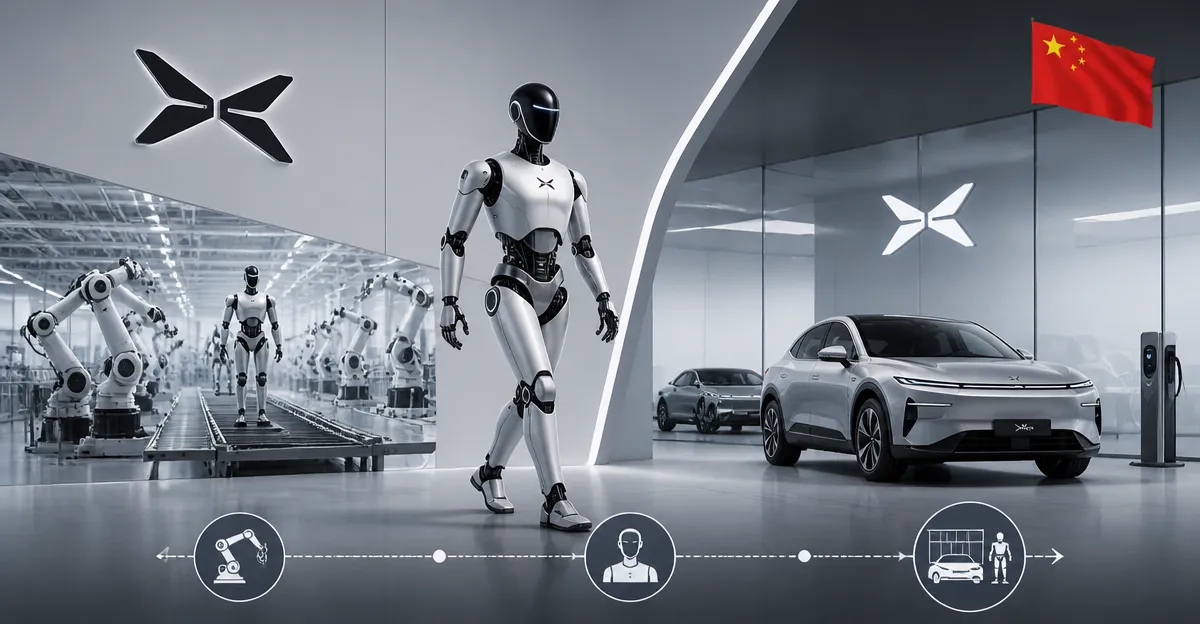
November 26, 2026, (Inside AI) — Chinese electric vehicle maker XPeng will start hardware production of its IRON humanoid robot in January 2027, with an external launch planned for the second quarter, CEO He Xiaopeng announced at the company's technology event on Wednesday. The robot will first work as a trainee sales assistant in XPeng's Chinese showrooms during the first quarter.
IRON walked onto the stage, delivered remarks in both Chinese and English, and interacted with journalists. XPeng said the demonstrations operated without human remote control. The company intends to use its stores and other workplaces as initial deployment environments while expanding the robot's capabilities.
He also outlined a potential business model combining hardware with software, token subscriptions, and services for specific tasks. XPeng plans to let partners distribute skills and models through its robot ecosystem. He said broader household adoption could come around 2029 or later, identifying safety and the ability to perform practical tasks as essential requirements.
The move places XPeng among a growing list of automakers leveraging their manufacturing expertise for humanoid robots. Tesla has been developing its Optimus robot, while other Chinese firms like UBTech and Xiaomi have also shown prototypes. XPeng's decision to deploy IRON in its own showrooms mirrors Tesla's strategy of using its facilities as test beds.
XPeng's approach stands out for its emphasis on a software and services ecosystem. The company envisions a platform where third-party partners can distribute skills and models, potentially creating an app store-like marketplace for robotic capabilities. This contrasts with rivals that focus primarily on hardware sales.
He Xiaopeng's timeline for household adoption around 2029 suggests the company sees a multi-year path to maturity. Safety and practical task performance remain key hurdles. The initial deployment as a sales assistant will allow XPeng to gather real-world data and refine the robot's capabilities in a controlled environment.
The announcement comes as XPeng faces increasing competition in China's EV market. Diversifying into robotics could open new revenue streams and position the company as a broader technology player. However, the humanoid robot market is still nascent, and profitability remains uncertain.
XPeng's production timeline is aggressive. Starting hardware production in January 2027 and launching externally by the second quarter leaves little room for delays. The company will need to ramp up manufacturing and ensure reliability. The success of IRON will depend on how well it performs in showrooms and whether XPeng can attract partners to its ecosystem.
He Xiaopeng's comments at the technology event underscore XPeng's ambition to become a leader in embodied AI. The company's experience in autonomous driving and manufacturing could give it an edge. But the humanoid robot space is crowded, and XPeng will need to differentiate itself through software and services.
As XPeng prepares for production, the industry will watch closely to see if IRON can deliver on its promises. The robot's debut in showrooms will be the first real test of its capabilities and appeal.

Tobias is less interested in what a robot or a prompt can do today than in what it means for tomorrow. He writes about prompt engineering and robotics for readers who want context, not just specs.